

I want to be straight with you from the first paragraph: I almost did not write this review. Not because I have nothing to say about Vimerson Health Glucosamine Chondroitin MSM, but because joint supplements collect more wishful thinking than almost any other category. People buy them hoping for something dramatic and fast. That is not what happens. And most reviews, the kind that just list ingredients and paste a five-star rating at the top, do not tell you that.
I am 62. I spent 28 years teaching health education in public schools. I am skeptical by training and by nature. When my left knee started making itself known every morning around mile two of my walk, I did not reach for a supplement first. I stretched more, I iced it, I slowed my pace. Six weeks of that and I was still getting the same stiffness by the time I hit the downhill on Birchwood Road. That is when I decided to give glucosamine a proper trial, and I mean proper: daily dosing, consistent timing, no other major changes, and a willingness to wait the full 12 weeks before drawing any conclusions.
The Quick Verdict
A solid, low-cost entry point for joint support, but only for the right person, only with the right expectations, and definitely not before you read the label carefully.
Amazon Check Today's Price →If you're on the fence and the price is what's holding you back, that part is easy.
At under $23 for 30 servings, this is one of the lower-stakes ways to run a genuine 8-week trial. The question is not the price. The question is whether this is right for your situation. Keep reading before you decide.
Amazon Check Today's Price on Amazon →What the Bottle Does Not Tell You
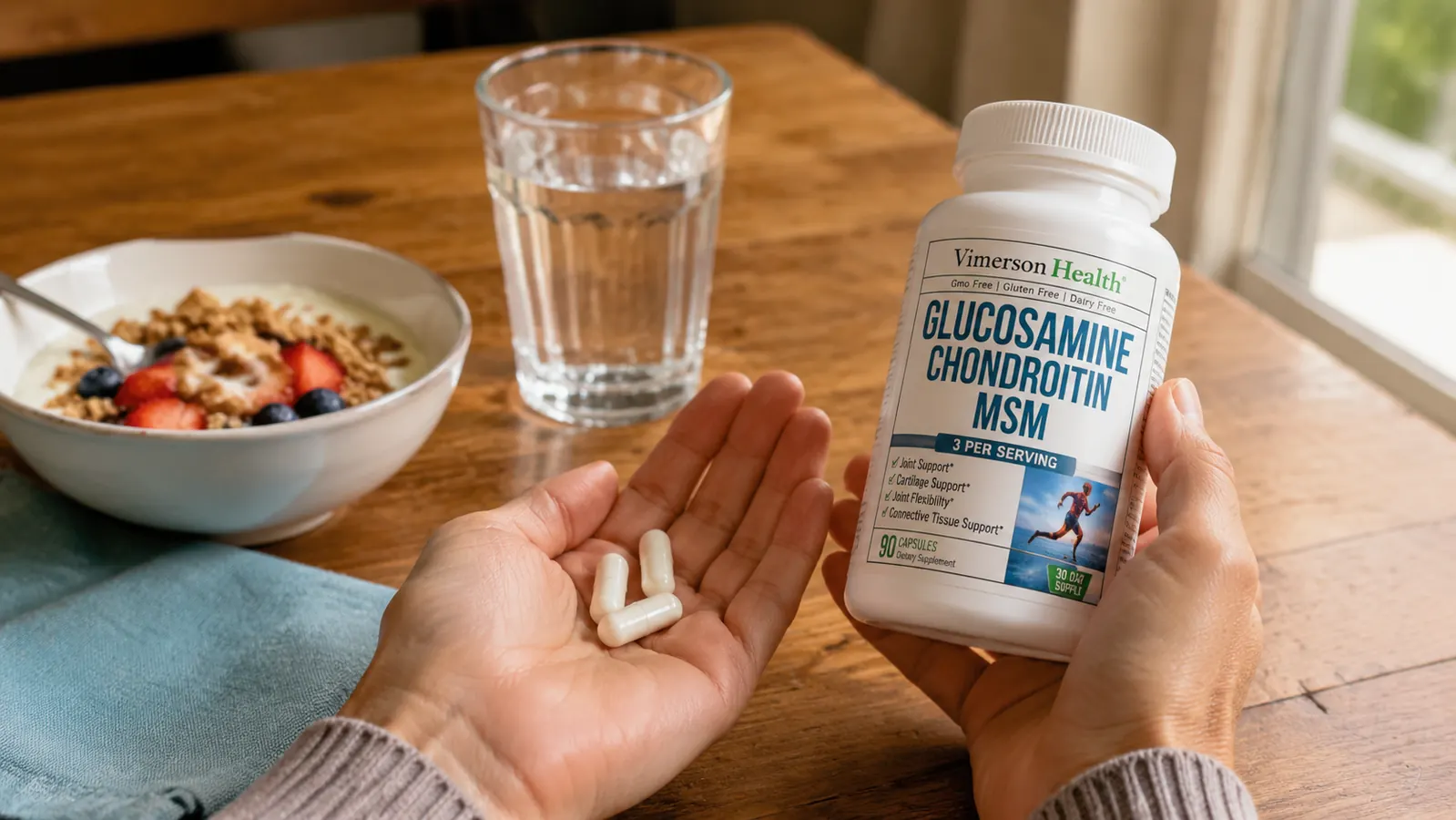
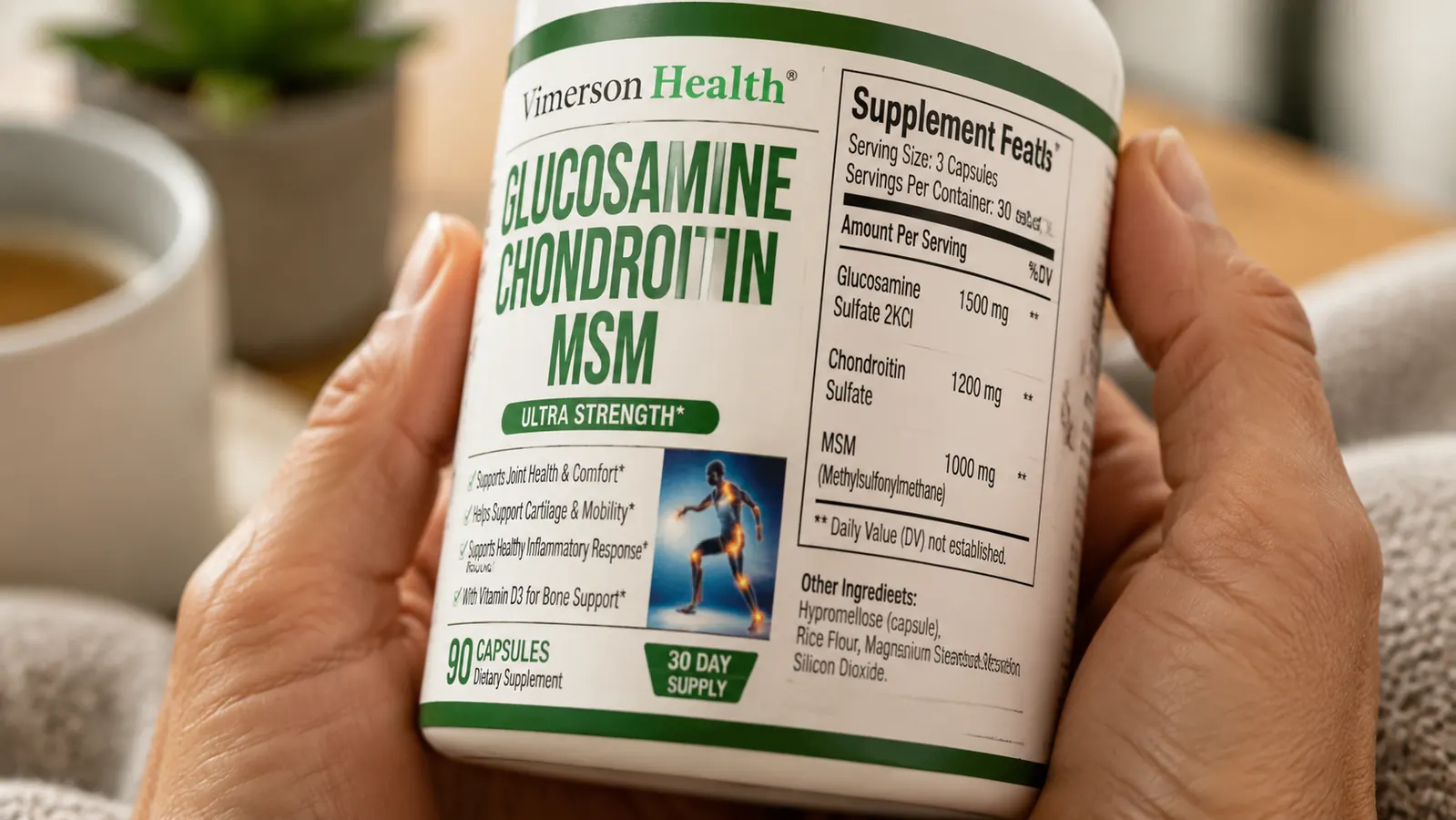
The label on Vimerson Health Glucosamine Chondroitin MSM tells you the dose: 1500mg glucosamine sulfate, 1200mg chondroitin, and 1000mg MSM per three-capsule serving. It tells you to take it with food. It tells you to consult your physician. What it does not tell you is that the research on these three ingredients is genuinely mixed, that the effect size in most studies is modest, and that anywhere from 30 to 40 percent of people in clinical trials do not respond meaningfully at all.
That is not a knock on this particular product. It is a feature of the ingredient category. The GAIT trial, which is the largest NIH-funded study on glucosamine and chondroitin, found that the combination may help a subgroup of people with moderate to severe knee pain, but showed less benefit for mild pain. If your joints are mildly uncomfortable, the numbers are less encouraging than most supplement marketing would have you believe. I share this not to talk you out of trying it, but because I think you deserve to know what the research actually says so you can calibrate your expectations correctly.
The three-capsule serving size is also something worth noting before you open the bottle. These capsules are large. Not impossible, but noticeably bigger than a standard vitamin. For anyone who already takes a handful of supplements in the morning, adding three more large capsules to the lineup is a real consideration. I take mine with breakfast and a full glass of water, and that has worked fine for me. But if you have any trouble swallowing large pills, factor that in.
Who Should Not Take This
This section matters more than any score I could give. There are specific groups of people who should either skip this supplement entirely or have a careful conversation with their doctor before starting.
Shellfish allergy is the first and most important one. The glucosamine in most supplements, including this one, is derived from shellfish shells. The protein that causes allergic reactions is typically removed in processing, but the risk is not zero. If you have a shellfish allergy, talk to your allergist before taking any glucosamine product. This is not a small-print footnote. It is a real consideration.
Blood thinners are the second concern. Chondroitin has mild blood-thinning properties. If you are already on warfarin, aspirin therapy, or any anticoagulant, adding chondroitin to your daily routine can affect how those medications work. Your doctor needs to know, and you may need more frequent INR monitoring, at least at first. This is not theoretical. There are documented interactions in the literature.
Diabetes and blood sugar management is the third area to flag. Some early research raised concerns that glucosamine might affect insulin sensitivity. The evidence on this is not definitive, but if you are managing type 2 diabetes or monitoring your glucose closely, it is worth discussing with your physician before adding 1500mg of glucosamine daily to your routine. The prudent move is to check your blood sugar more frequently in the first few weeks and see how your body responds.
Pregnancy and nursing round out the caution list. There is simply not enough research on these compounds during pregnancy to recommend them. Skip it until you are in a different season.
The First Two Weeks: What to Actually Expect
Here is where most reviews go wrong. They either promise fast results or say nothing at all about the early weeks, which is exactly when people are most likely to quit.
In the first two weeks, some people experience mild gastrointestinal upset. Nausea, loose stools, or a general heaviness in the stomach after taking the capsules. This is fairly common and usually settles down by week three. Taking the capsules with a full meal rather than just a snack helps considerably. I noticed a mild stomach awareness the first four or five days, nothing dramatic, but it was there. By day ten it was gone.
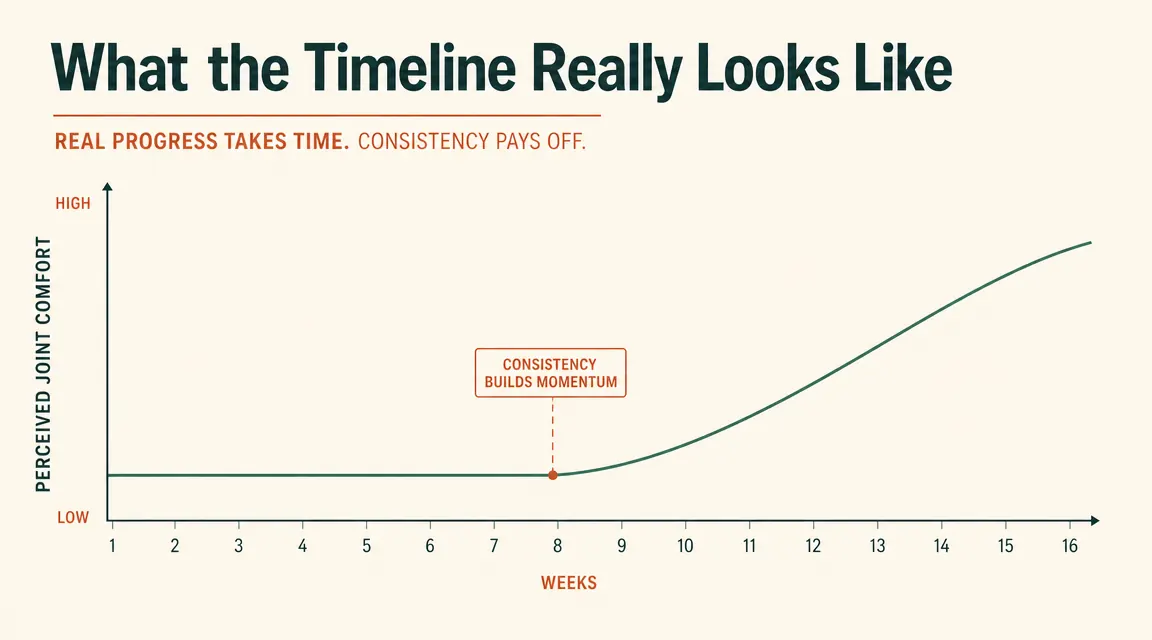
What you should not expect in the first two weeks is any noticeable change in your joints. Glucosamine and chondroitin are not anti-inflammatory drugs. They do not block pain signals the way ibuprofen does. The proposed mechanism is slower: they may support cartilage health over time by providing raw materials the body uses in connective tissue. That process, if it works for you, takes time. The honest window is 8 to 12 weeks of consistent daily use before you have enough information to decide if this is doing anything.
I marked week eight on my calendar before I even opened the bottle. If I had judged this at week four, I would have thrown it out. That would have been a mistake.
I started keeping a simple morning note on my phone. One sentence about how my knee felt before my walk. Not scientific, but it gave me something to look back at instead of relying on memory, which is notoriously unreliable when you are evaluating slow-moving changes. That log is the only reason I can say with any confidence what changed and when.
What I Actually Noticed After Eight Weeks
Around week nine, I noticed I was getting to Birchwood Road without thinking about my knee first. That sounds small. It was not small. For the six weeks before I started the supplement, that downhill section was the thing I braced for every morning. At week nine, I only noticed that I had not been bracing when I was already past it.
By week twelve, my morning stiffness was shorter. Not gone. Shorter. I still feel some tightness when I first get out of bed, but it loosens up within five or ten minutes instead of taking the whole first mile. That is a meaningful improvement for my life, even if it would not show up dramatically on a standardized pain scale.
I want to be clear about what I cannot attribute to this supplement: I was also sleeping better during this period, I had reduced my evening wine from most nights to weekends, and I added a short hip flexor stretch to my morning routine. Any of those things could have contributed to what I was feeling. Supplements do not come with control groups. That ambiguity is real, and anyone who tells you otherwise is overselling their certainty.

The Ingredients: What the Dose Actually Means
The 1500mg of glucosamine sulfate per serving matches the dosage used in the most frequently cited long-term clinical trials. That is a meaningful data point. A lot of cheaper products use 500mg or 750mg and hope you do not check. Vimerson uses the dose that has actually been studied, which is one reason I chose it for my trial.
The 1200mg of chondroitin is similarly at the research-supported level. MSM at 1000mg is a reasonable dose, though the evidence base for MSM specifically is thinner than for the other two. It is included in a lot of joint formulas because some smaller studies suggest it may reduce exercise-induced joint soreness. For someone like me who is active most days, that is a plausible benefit, even if the science is less settled.
The formula is also free of shellfish-derived ingredients at the protein level, though again, the base glucosamine is shellfish-derived. It does not contain artificial colors, preservatives, or fillers. The capsule count works out to a 30-day supply at the full three-capsule dose, which is important to know before you calculate cost per month.
The Price Question
At around $23 for a 30-day supply, this is one of the more affordable options in the category with a full research-level dose. It is not cheap in absolute terms. Running a proper 12-week trial costs you somewhere around $69 if you buy three bottles. That is real money. But compared to the prescription alternatives, the physical therapy co-pays, or the cost of stepping back from the activities you love, it is a relatively low-risk experiment.
Where it compares well against pricier brands is in ingredient transparency and dose accuracy. Where it compares less well is in third-party testing and certification. Premium brands like Thorne or Life Extension pay for independent verification of what is actually in the capsule versus what the label claims. Vimerson does not prominently feature third-party certifications. For a supplement you are taking daily for months, that is a fair thing to care about.
What I Liked
- Uses research-level doses of all three active ingredients
- One of the more affordable full-dose options in the category
- No artificial colors, fillers, or unnecessary additives
- Three-capsule serving is easy to adjust or split across the day
- 43,000-plus reviews on Amazon provide a large real-world data set
- GI upset typically resolves within the first ten days with food
Where It Falls Short
- No prominent third-party testing certification
- Glucosamine is shellfish-derived, relevant for allergy concerns
- Three large capsules per serving is a real consideration for pill-averse users
- Requires 8 to 12 weeks of consistent use before meaningful evaluation
- 30 to 40 percent of users in clinical categories see limited benefit
- Possible interactions with blood thinners and blood sugar management require physician review
Who This Is For
This supplement makes sense for active adults who have mild to moderate joint stiffness, no shellfish allergy, no blood thinner use, and the patience to run a genuine 12-week trial. If you are walking, gardening, hiking, or chasing grandkids and your joints are starting to register an opinion about it, a full-dose glucosamine chondroitin MSM product at a research-supported level is a reasonable thing to try. It has a low price-to-trial cost, the dose is correct, and the formula is clean.
It also makes sense for people who want to be methodical about it. Keep a simple note. Mark week eight on your calendar. Give it its full shot before you decide.
Who Should Skip It
Skip this one if you have a shellfish allergy and have not cleared it with your allergist. Skip it if you are on warfarin, Eliquis, or any anticoagulant without having that conversation with your prescribing doctor first. Skip it if you expect to feel something in the first two or three weeks and will bail if you do not. The frustrating truth is that quitting at week four is the most common reason people conclude glucosamine does not work for them, when what actually happened is they did not give it long enough to know.
Also skip it if you are dealing with acute joint pain, swelling, or recent injury. This is a long-term support supplement, not an acute treatment. For anything that appeared suddenly or is getting worse, your doctor is the right first call, not Amazon.
If everything in this review fits your situation, the trial cost is low and the dose is right.
I have been honest about who this is not for. If you do not fall into any of those categories, and you are willing to give it the full 8 to 12 weeks it needs, this is a reasonable supplement to add to a thoughtful joint-support routine. Check the current price and see if it makes sense for your budget.
Amazon Check Today's Price on Amazon →