

I've stood in that supplement aisle more than once, staring at a wall of joint support bottles, reading labels that use nearly identical words in slightly different order, and thinking: how is anyone supposed to know which one is right? My knees started complaining seriously about four years ago, right around when I began leading longer day hikes with my husband. I eventually figured out what to look for, and the process was mostly trial, error, and a lot of label squinting. This guide is what I wish someone had handed me back then.
If you're active after 60 and you're considering glucosamine chondroitin for joint support, the good news is that this category is not as complicated as the shelves make it look. There are really six things worth getting right: the form of glucosamine, the dosage, what the label should and should not say, shellfish allergy risk, whether to include MSM, and realistic expectations for timing. Walk through each of these and you'll be able to find a product that fits your situation, whether you're a gardener, a walker, a traveler, or all three.
If you'd rather skip the research and start with something that already checks every box
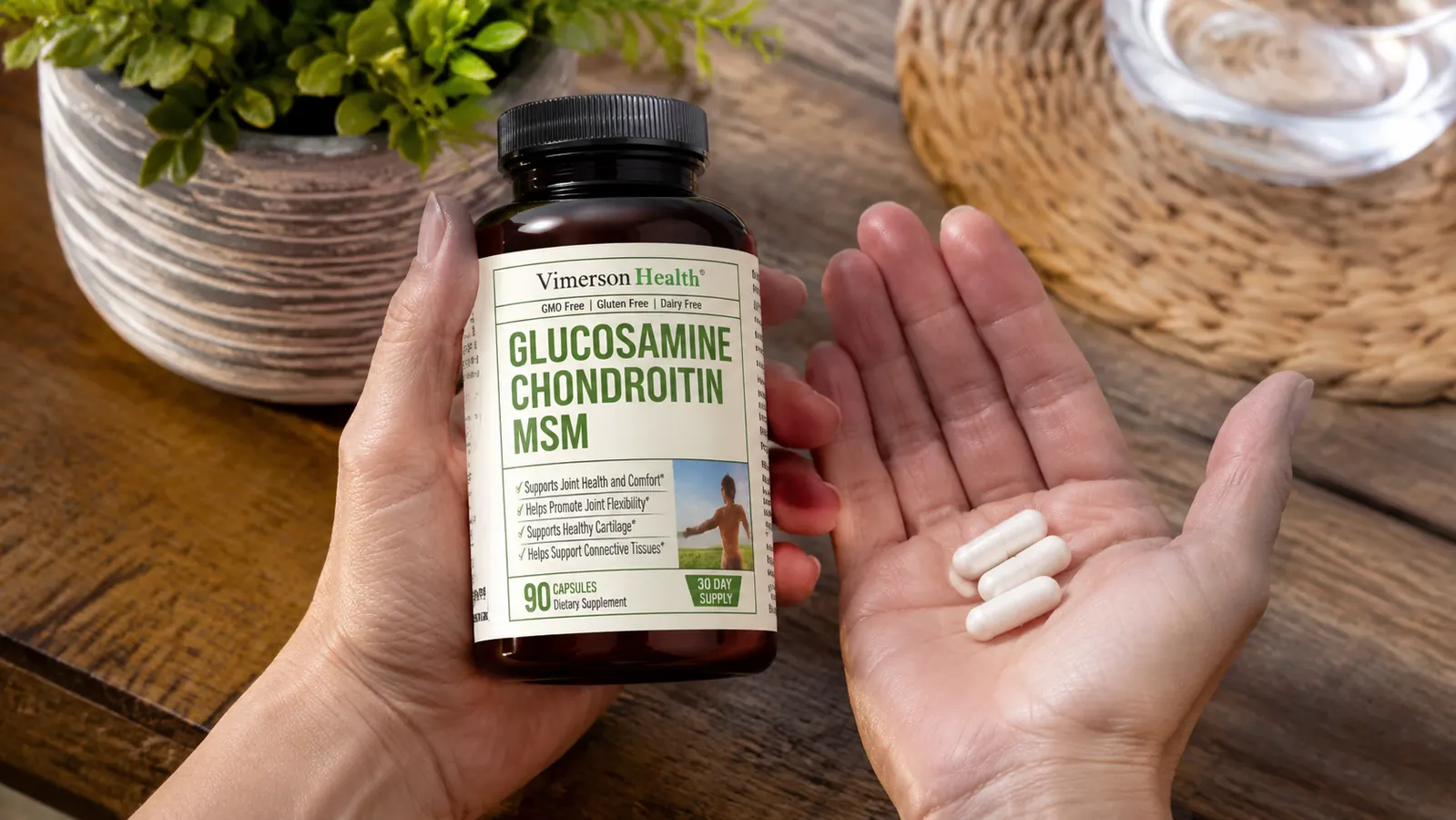
Vimerson Glucosamine Chondroitin MSM has over 43,000 Amazon reviews, uses glucosamine sulfate at the clinically studied 1500 mg dose, and includes MSM alongside chondroitin in a single capsule. It's the formula I use on travel days and long hiking weeks.
Amazon Check Today's Price on Amazon →Step 1: Choose Glucosamine Sulfate Over Glucosamine HCl
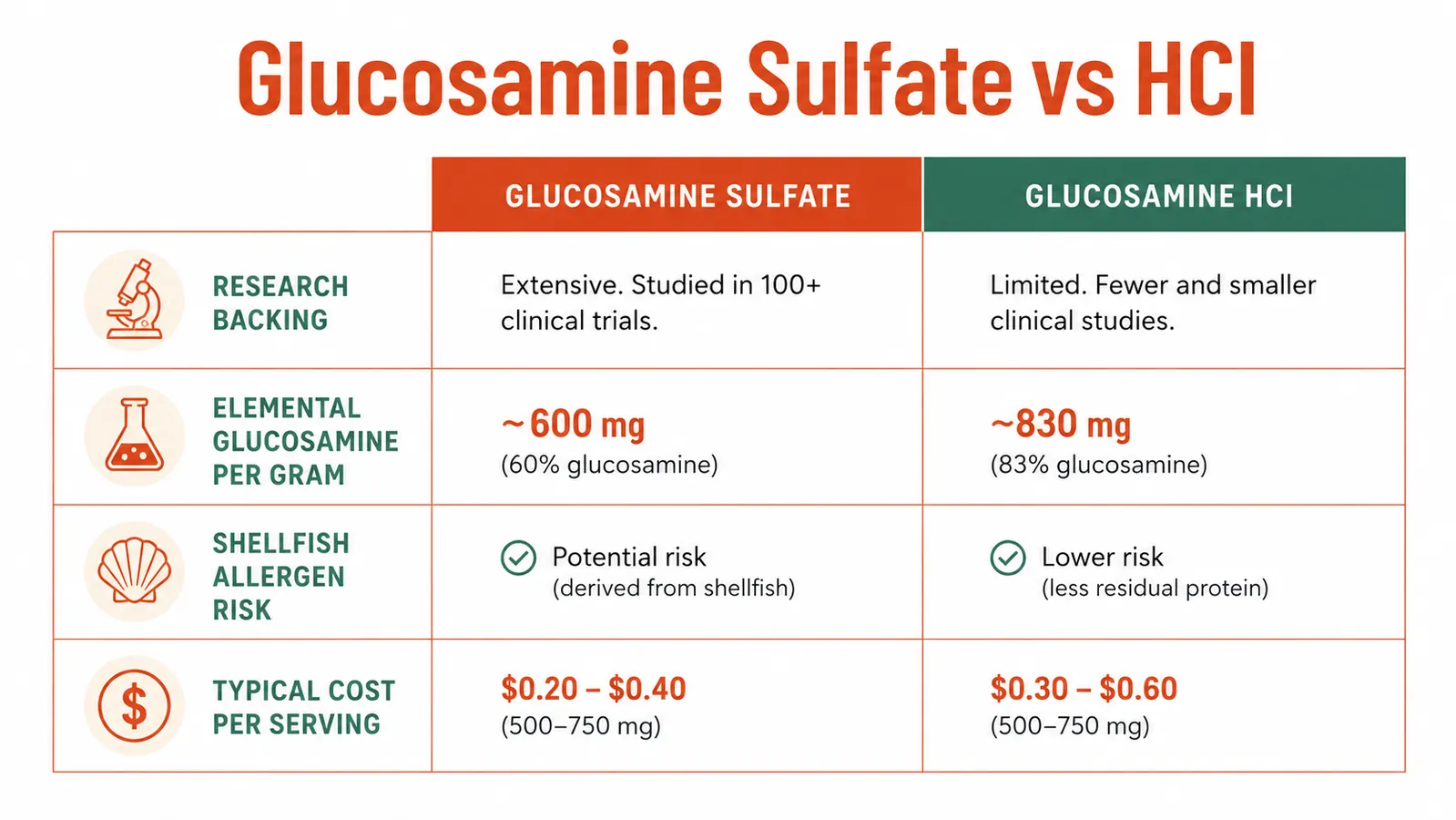
This is the first thing I look at on any label, and it's also the thing most people skip entirely. Glucosamine comes in two main forms: glucosamine sulfate and glucosamine hydrochloride (HCl). They sound similar but they are not equivalent when it comes to the research behind them.
Glucosamine sulfate is the form used in the major long-term studies on joint cartilage. The sulfate portion of the molecule may matter on its own, since sulfur is involved in the maintenance of connective tissue. Glucosamine HCl has a higher concentration of actual glucosamine per gram, which is why some manufacturers prefer it, but the bulk of the clinical evidence points to the sulfate form. When I was trying to sort this out, my rule became simple: if the label says 'glucosamine' without specifying sulfate, I put it back.
Vimerson uses glucosamine sulfate at 1500 mg, which is the dose most commonly studied. That's what made it my starting point.
Step 2: Confirm the Dosage Is Actually Meaningful
This step catches a surprising number of products that look identical on the shelf. The clinically studied dosage for glucosamine sulfate is 1500 mg per day. For chondroitin, it's typically 1200 mg per day. Some products hit those numbers in a single serving. Others spread a low-dose formula across three capsules and still come in well under the studied amounts.
Look at the serving size, then do the math. If a label shows 500 mg glucosamine per capsule and instructs you to take one capsule per day, you're getting a third of the dose that researchers have studied. That's not necessarily useless, but it's not what the research was done with. I look for at least 1500 mg of glucosamine sulfate and 1200 mg of chondroitin in whatever the daily serving size turns out to be.
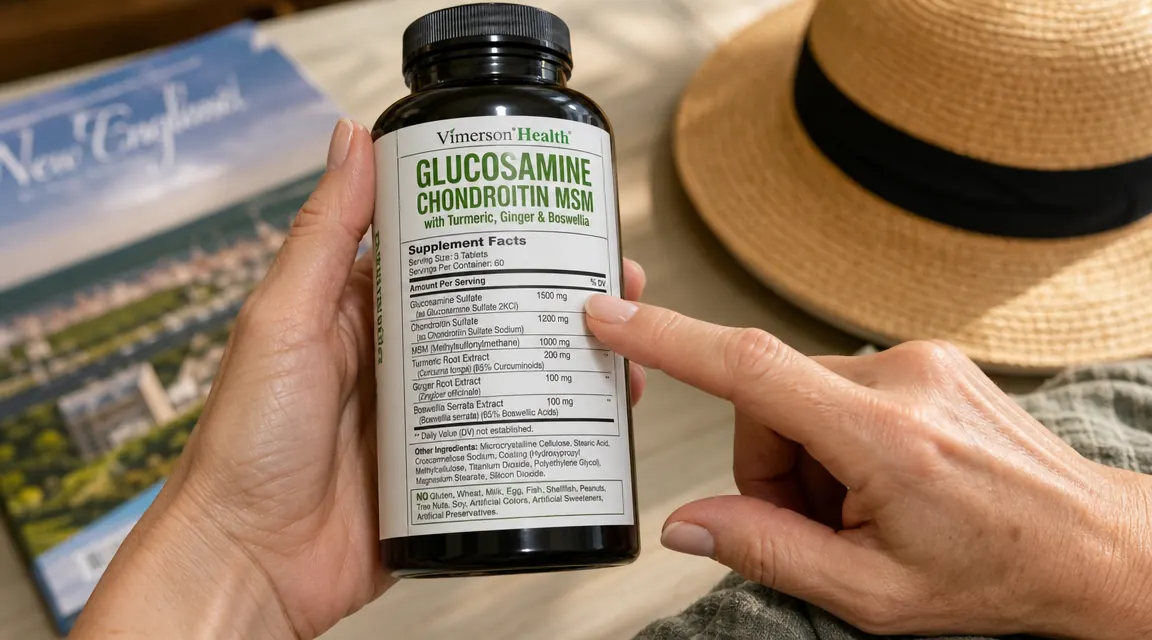
Vimerson's three-capsule daily serving delivers 1500 mg glucosamine sulfate and 1200 mg chondroitin. That matches the studied dosages, which is one reason I trust it as a baseline.
Step 3: Read the Full Ingredient List Before You Buy
Once I confirm the form and dose, I read the full ingredient list. There are a few things worth looking for, and a few things worth avoiding.
On the 'look for' side: chondroitin sulfate (ideally at 1200 mg per day), MSM if you want it (more on that in a moment), and clean binders and fillers. Cellulose, magnesium stearate, and silicon dioxide are common and generally fine. On the 'avoid' side: proprietary blends where you can't see individual ingredient amounts, and products that mix glucosamine with a long list of herbs or botanical extracts that haven't been studied alongside it. Those additions can be legitimate, but they make it harder to know what's actually doing the work if the product helps, and what to cut out if your stomach objects to something.
I also check whether the product has been third-party tested. Vimerson is manufactured in an NSF-registered facility. That's not the same as a full USP or NSF certification, but it's a reasonable baseline compared to brands that offer no quality information at all.
The label rarely lies outright. It just lets you overlook things. Once you know what to look for, shopping for a joint supplement takes about three minutes.

Step 4: Know Your Shellfish Allergy Risk Before You Commit
This is the step that catches people off guard. Glucosamine is derived from shellfish, typically shrimp shells or crab shells. If you have a known shellfish allergy, that is not a minor detail. Reactions can be serious. This applies to glucosamine sulfate and glucosamine HCl alike, since both are typically sourced from shellfish.
If you have a shellfish allergy, the conversation starts and ends with your doctor, not with a supplement label. There are synthetic, non-shellfish-derived glucosamine products available, but they are less common and the research base is thinner. Anyone with a known shellfish allergy should discuss alternatives with a healthcare provider before going anywhere near this category.
For everyone without a shellfish allergy, this is a non-issue. But it's worth knowing because a lot of people take this supplement for years without ever realizing the shellfish connection. Chondroitin, for what it's worth, is typically derived from bovine cartilage, not shellfish. So the allergy concern is glucosamine-specific.
Step 5: Decide Whether to Include MSM
MSM stands for methylsulfonylmethane. It's a sulfur compound that's often included in joint supplements alongside glucosamine and chondroitin, and it has its own separate body of research for joint comfort. When I first started looking at joint supplements, I wasn't sure whether MSM was a meaningful addition or just a marketing add-on.
What I've found, after trying both, is that the combination formula seems to work better for me than glucosamine and chondroitin alone. The research on MSM suggests it may help with joint comfort and flexibility, particularly in people who are active. Some studies have looked at the combination of all three and found additive effects. Whether or not that's the case for you individually is impossible to predict, but the tradeoff is mostly cost. MSM products are not dramatically more expensive than basic glucosamine chondroitin.
Vimerson includes 500 mg of MSM per serving alongside the glucosamine and chondroitin. That's in the lower range of what some studies have used (some go up to 1500 mg of MSM alone), but it's a reasonable starting point in a combination formula. If you're specifically after higher-dose MSM, you'd want a dedicated MSM product rather than a combination supplement.
My general advice: if you're new to this category, start with a formula that includes MSM. If you have a specific reason to avoid it, look for a glucosamine sulfate and chondroitin formula without it. Either is a reasonable approach.
Step 6: Set a Realistic Timeline Before You Judge the Results
This is the step that determines whether most people stick with joint supplements or quit too early. Glucosamine and chondroitin are not pain relievers in the conventional sense. They don't block inflammation pathways the way ibuprofen does. They work, when they work, by supporting cartilage structure over time. That means the timeline is weeks and months, not days.
Most people who respond positively to this combination report noticing something in the six-to-eight-week range. Some take longer. Some notice subtle changes first: a little less stiffness when getting out of a chair, knees that complain less at the end of a long walk, hips that don't protest the stairs as much. The changes are usually incremental, not dramatic.
I took Vimerson for about six weeks before I felt like I had enough information to form an opinion. By week four, I noticed my knees were less stiff after long hikes. By week eight, that improvement felt consistent enough that I stayed with it. I've now taken it for over nine months, and the joint support I've felt through long travel days, garden work in spring, and fall hiking trips has made it a permanent part of my routine. The rating on Amazon, 4.5 stars across more than 43,000 reviews, reflects what I've heard from other people: it works for a lot of active adults, it takes patience, and the people who quit at week three usually don't know what they missed.
What Else Helps
A joint supplement works best when it's part of a broader approach to staying mobile. Staying hydrated matters more than most people realize, since cartilage is largely water. Low-impact movement like walking, swimming, or cycling keeps joints lubricated better than rest does. Weight management takes significant load off knees and hips, and the difference even a few pounds makes on joint stress over a long walk is real. Omega-3 fatty acids may help with joint inflammation and pair well with glucosamine chondroitin if you're not already taking them.
None of those things replace each other. The supplement is one piece, not the whole answer. But as pieces go, it's one of the easier ones to add.
Six weeks is the minimum honest test. Joint supplements work slowly by design. Give them time and keep moving.
You've done the homework. Here's the formula I'd start with.
Vimerson Glucosamine Chondroitin MSM uses glucosamine sulfate at 1500 mg, chondroitin at 1200 mg, and MSM at 500 mg per day. Clean ingredient list, NSF-registered facility, and over 43,000 reviews from people who walk, garden, travel, and hike. It's the straightforward option for active adults who want a solid baseline formula without over-complicating it.
Amazon Check Today's Price on Amazon →