

I switched to flaxseed oil three years ago because a friend told me it was cleaner, plant-based, and just as good as fish oil for brain support. I took it every morning for six months. And by the end of those six months, I was still reaching for words mid-sentence, still feeling foggy on the back half of my afternoons, still not quite as sharp as I wanted to be heading into my sixties. It was not until I switched to a triple-strength fish oil that things actually shifted. I wish someone had explained the conversion problem to me earlier. It would have saved me a lot of months and a fair amount of money.
Here is the honest version of this comparison: both oils contain omega-3s, but the form of those omega-3s is not the same, and your body treats them very differently. If you are over 60 and your primary goal is brain clarity, focus, and memory support, that difference matters quite a bit. Let me walk you through it.
| Factor | Sports Research Fish Oil (Left) | Flaxseed Oil (Right) |
|---|---|---|
| Active omega-3 forms | EPA and DHA delivered directly | ALA only, must be converted by the body |
| Conversion to brain-usable DHA | Not required, DHA is pre-formed | Estimated 0 to 4% of ALA converts to DHA |
| Bioavailability | High, especially with meals containing fat | Lower for brain-critical forms |
| Vegetarian or vegan friendly | No, sourced from wild Alaska Pollock | Yes, entirely plant-based |
| Typical cost per serving | Around $0.31 per softgel | Often lower, varies by brand |
| Fishy aftertaste risk | Low in quality brands, minimal with food | None |
| Side effects at normal doses | Occasional mild GI upset | Occasional loose stools at high doses |
| Mercury or contaminant risk | Low in molecularly distilled products | Not applicable, plant source |
| Third-party or sustainability certification | MSC certified, non-GMO verified | Varies by brand |
| Best fit for | Brain, heart, joint, and inflammation support | General omega-3 intake, vegan diets, ALA benefits |
Where Fish Oil Wins
The biggest gap between these two oils comes down to one thing: what your brain actually uses. DHA, which stands for docosahexaenoic acid, makes up roughly 30 percent of the fatty acids in your brain's gray matter. EPA supports inflammation regulation and mood. Fish oil delivers both directly, in forms your body can put to use without any conversion step. Sports Research Triple Strength provides 1250 mg of total omega-3s per softgel, including a substantial EPA and DHA load, sourced from wild Alaska Pollock and certified by the Marine Stewardship Council for sustainable fishing practices.
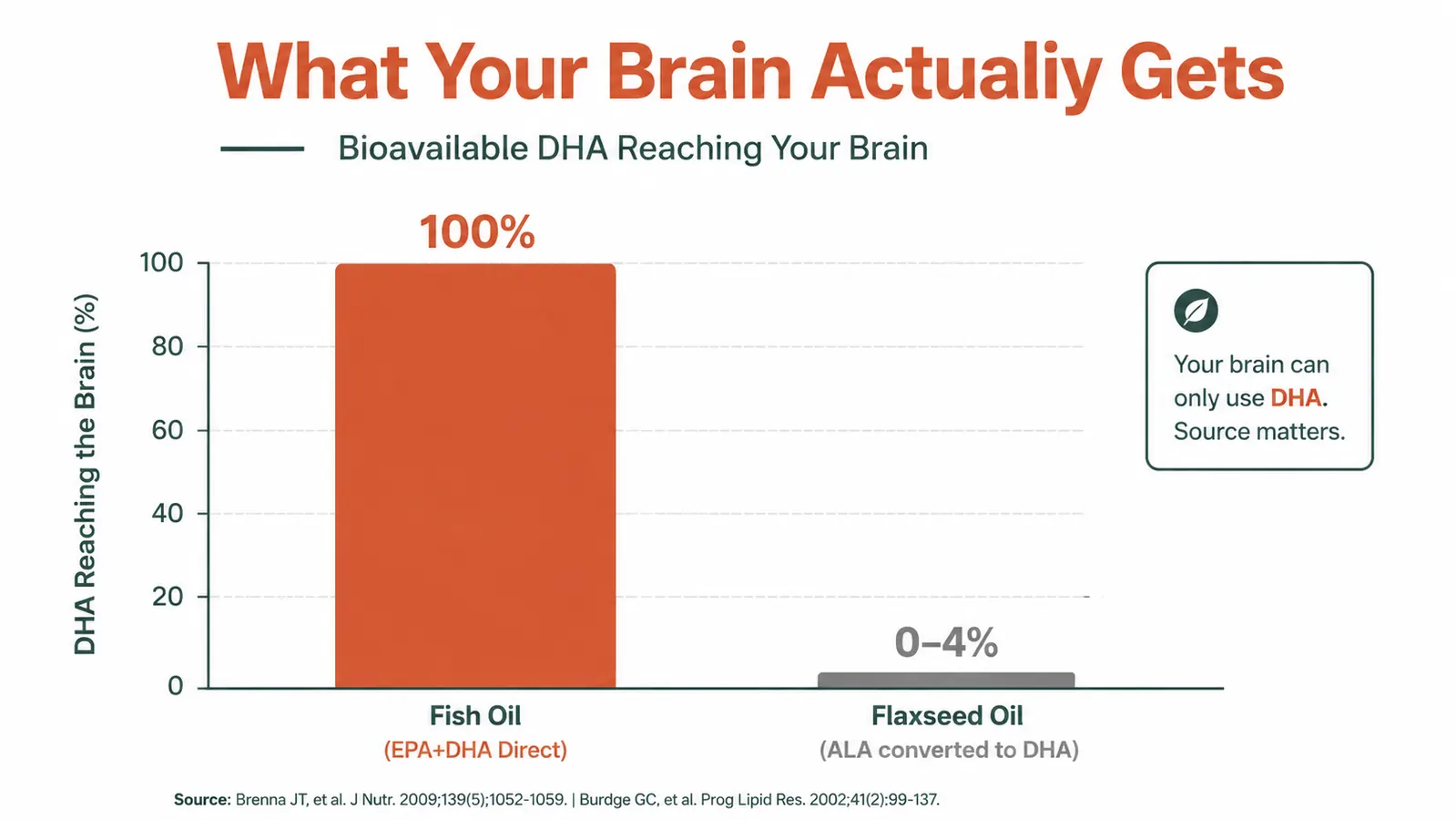
After 60, this directness matters more than it did at 40. As we age, the body's ability to efficiently convert ALA into the longer-chain EPA and DHA becomes less reliable. Research suggests conversion rates for ALA to DHA range from roughly zero to four percent in most adults, and that rate may decline further with age. If you are taking flaxseed oil hoping your brain is receiving meaningful DHA, the math is working against you. A tablespoon of flaxseed oil might contain around 7 grams of ALA. Your brain may receive somewhere between zero and a few hundred milligrams of DHA from that. Fish oil removes this guesswork entirely.
Your brain wants DHA. Fish oil delivers it without the conversion math.
Sports Research Triple Strength Omega-3 is sourced from wild Alaska Pollock, MSC certified for sustainability, and provides EPA and DHA your body can use directly. Over 59,000 Amazon ratings back it up.
Amazon Check Today's Price on Amazon →
Where Flaxseed Oil Wins
Flaxseed oil is not a bad supplement. It is just not the right one if your primary concern is brain-specific omega-3 support. Where flaxseed genuinely earns its place is in plant-based diets. If you do not eat fish, if you are vegetarian or vegan, or if you have a fish allergy, flaxseed oil gives you ALA omega-3s that carry their own health associations, particularly around cardiovascular support and general inflammation. Some people also tolerate flaxseed oil better from a digestive standpoint, since there is no fish-derived content.
Flaxseed oil also tends to cost less per serving, which matters for people on fixed budgets. And for someone who is not specifically targeting brain health, the ALA in flaxseed oil may still contribute to overall omega-3 intake in a way that is meaningful. The problem is that most of the research behind omega-3s and cognitive support focuses specifically on EPA and DHA, not ALA. If the brain health angle is what brought you to this comparison, flaxseed oil is starting a few steps behind.
I spent six months taking flaxseed oil expecting the same brain support I eventually got from fish oil. The conversion problem is real, and most labels do not explain it.
The Conversion Problem, Explained Plainly
ALA is a short-chain omega-3 found in plant sources like flaxseed, walnuts, and chia seeds. Your body needs to convert it into EPA and then from EPA into DHA before it can use it for brain and nervous system support. This conversion depends on enzymes that are also used by omega-6 fatty acids, and most of us in Western diets already have a high omega-6 load from cooking oils and processed foods. Those enzymes are busy. The conversion pathway gets crowded.
Studies show that this conversion is highly variable and generally low, typically between 0.2 percent and 8 percent for EPA and even lower for DHA, sometimes under 1 percent. That is not a typo. Less than one percent of the ALA in flaxseed oil may reach the form your brain actually incorporates into its cell membranes. Fish oil bypasses this entirely. The EPA and DHA are pre-formed, pre-converted, and ready for your body to use.
Why Quality Matters When Choosing Fish Oil
Not all fish oils are equal, and this is where many people get burned. Cheap fish oil products can be oxidized before they even hit the shelf, which means rancid fats packaged in softgels that smell sour when you bite them. They may also be underdosed, containing far less EPA and DHA than the label suggests. Some are sourced from fish lower on the food chain that still carry environmental contaminants.
Sports Research uses wild Alaska Pollock, a cold-water fish that sits lower on the food chain than tuna or swordfish, which helps keep contaminant loads low. The product is molecularly distilled to remove heavy metals and is third-party tested for purity. The softgels are coated to minimize burp-back, which is one of the most common complaints with fish oil in general. I have been taking these for over a year and the only time I notice any fish taste is if I take a capsule on a completely empty stomach, which the label advises against anyway.

Who Should Buy Which
Choose fish oil if your main reason for taking omega-3s is to support brain clarity, memory, and focus. This is especially true if you are over 60, because the conversion pathway from ALA to DHA becomes less efficient with age and you want omega-3s in the form your brain can immediately use. Sports Research Triple Strength is the one I recommend because of the dose, the sourcing, the sustainability certification, and the track record across tens of thousands of verified buyers.
Choose flaxseed oil if you are vegetarian or vegan and cannot take fish-derived products, if you want general ALA omega-3 intake as part of a plant-based diet, or if you are adding it to a diet that is already high in EPA and DHA from whole food sources like fatty fish several times a week. In that case, flaxseed oil can complement what you are already getting. It should not be the sole strategy for brain omega-3 support.
There is also a middle option that some people explore: algae-based omega-3 supplements, which provide DHA and sometimes EPA from the same marine algae that fish eat in the first place. These are vegetarian-friendly and bypass the conversion problem. They tend to cost more than fish oil, but they are worth knowing about if plant-based is a hard requirement for you.
A Note on Expectations and Timelines
Neither supplement produces overnight results. When I started taking Sports Research Triple Strength, I noticed the first subtle changes, a bit more verbal fluency and slightly better focus in the mornings, at around the four to six week mark. The research generally suggests it takes two to three months of consistent use to see meaningful changes in omega-3 blood levels. Patience is part of the equation. That said, I did notice the difference between the fish oil period and the flaxseed oil period clearly enough that I have not gone back.
One practical note: take your omega-3 supplement with a meal that contains fat. Both fish oil and flaxseed oil are fat-soluble, which means absorption is significantly better when there is dietary fat present. I take mine with breakfast, usually alongside eggs or avocado, and that timing works well.
Ready to give your brain the omega-3s it can actually use?
Sports Research Triple Strength Omega-3 is MSC certified, non-GMO, soy-free, and built for people who want a clean, high-dose fish oil without the aftertaste. See current pricing and read verified buyer reviews on Amazon.
Amazon Check Today's Price on Amazon →