

Most people who write about Thorne Magnesium Glycinate love it. And honestly, I understand why. I have been sleeping better since I started taking it, and my legs stopped cramping during the night, which was a real problem for me last winter. But I spent two months trying to find a review that told me what I actually needed to know before spending the money, and I could not find one. Every article I read glossed over the price comparison, said nothing useful about side effects, and skipped the question of who probably should not bother. So that is the review I am writing.
I am Marty, 62, retired health teacher from outside Knoxville. I travel, I garden, I chase my four grandkids, and I have been testing supplements seriously for about three years because I got tired of guessing. I take notes. I read labels. I run the numbers. What follows is what I actually found, including the things that gave me pause.
The Quick Verdict
Genuinely effective magnesium glycinate from a brand with real quality standards, but the price is not automatically justified for every buyer. Worth it if purity and third-party certification matter to you. Worth skipping if you are price-sensitive and willing to do a bit more label reading.
Amazon Check Today's Price →Sleeping poorly and you've already tried the basics? This is the magnesium I'd point you toward.
Thorne Magnesium Glycinate is chelated, third-party certified, and free of the fillers that show up in cheaper capsules. It is not the cheapest option, but if you have been disappointed by other brands, the quality difference is real.
Amazon Check Today's Price on Amazon →What I Actually Did to Test This
I ordered Thorne Magnesium Glycinate after spending three weeks reading forums and comparing labels. I had been taking a cheaper store-brand magnesium oxide at night and getting mixed results, mostly because magnesium oxide is poorly absorbed and mostly just keeps you regular. I wanted to try a chelated form, specifically glycinate, because the research on absorption and sleep support is more convincing. I started on Thorne because I could verify their third-party testing, not because of the price.
I took two capsules every night with a small glass of water, about 45 minutes before bed. I kept that schedule for eight weeks. I tracked my sleep using a simple sleep log, not a wearable, because I find those devices create their own anxious loop. I noted how long it took me to fall asleep, whether I woke in the middle of the night, and how I felt at 6am. I also paid attention to digestive changes, muscle cramps, and how my legs felt after longer walks.
Week one was unremarkable. I was not expecting miracles and I did not get them. By week three I noticed that I was falling asleep faster on most nights, not dramatically, but the lying-awake-thinking time shortened. By week six the night cramps had almost completely stopped. Those are the results I care about most and they held through eight weeks. I want to be careful here because I cannot tell you why your sleep will change or whether it will, only what happened with mine.

What the Bottle Does Not Say
The label on Thorne Magnesium Glycinate is cleaner than most. No artificial colors, no gluten, no dairy, no soy. Each two-capsule serving delivers 200mg of elemental magnesium as magnesium bisglycinate chelate. That chelated form matters because it means the magnesium molecule is bonded to glycine, which makes it more stable in the digestive tract and generally gentler on the stomach than oxide or sulfate forms. That part Thorne does communicate clearly.
What the bottle does not mention is the glycine itself. Glycine is an amino acid that has its own calming effect on the nervous system. When you take magnesium glycinate, you are getting both the magnesium and a modest dose of glycine with each serving. That may be part of why this particular form of magnesium tends to support sleep better than others. It is not a secret, but Thorne markets this product on the magnesium, not on the glycine. Worth knowing if you are comparing this to a plain magnesium citrate supplement.
The bottle also does not address tolerance. Some people find that after several months of nightly use, the sleep effect levels off. I did not experience that in eight weeks but I have read enough user experiences to know it happens. If you are planning to use this long-term, it may be worth cycling off for a couple of weeks every few months. That is not Thorne-specific advice, it applies to magnesium supplementation in general.
The Price-Per-Serving Question You Should Actually Ask
This is where I have to be straight with you. Thorne Magnesium Glycinate runs about 90 capsules for the current price, which works out to 45 servings if you are taking the two-capsule dose. That puts the cost per serving meaningfully higher than several well-regarded competitors. Doctors Best, for example, uses the same chelated bisglycinate form, is also third-party tested by NSF, and comes in at roughly half the per-serving cost. Pure Encapsulations offers a comparable formula in a similar price tier to Thorne. Bulk Supplements sells pure magnesium glycinate powder at a fraction of the capsule cost, though you give up the convenience.
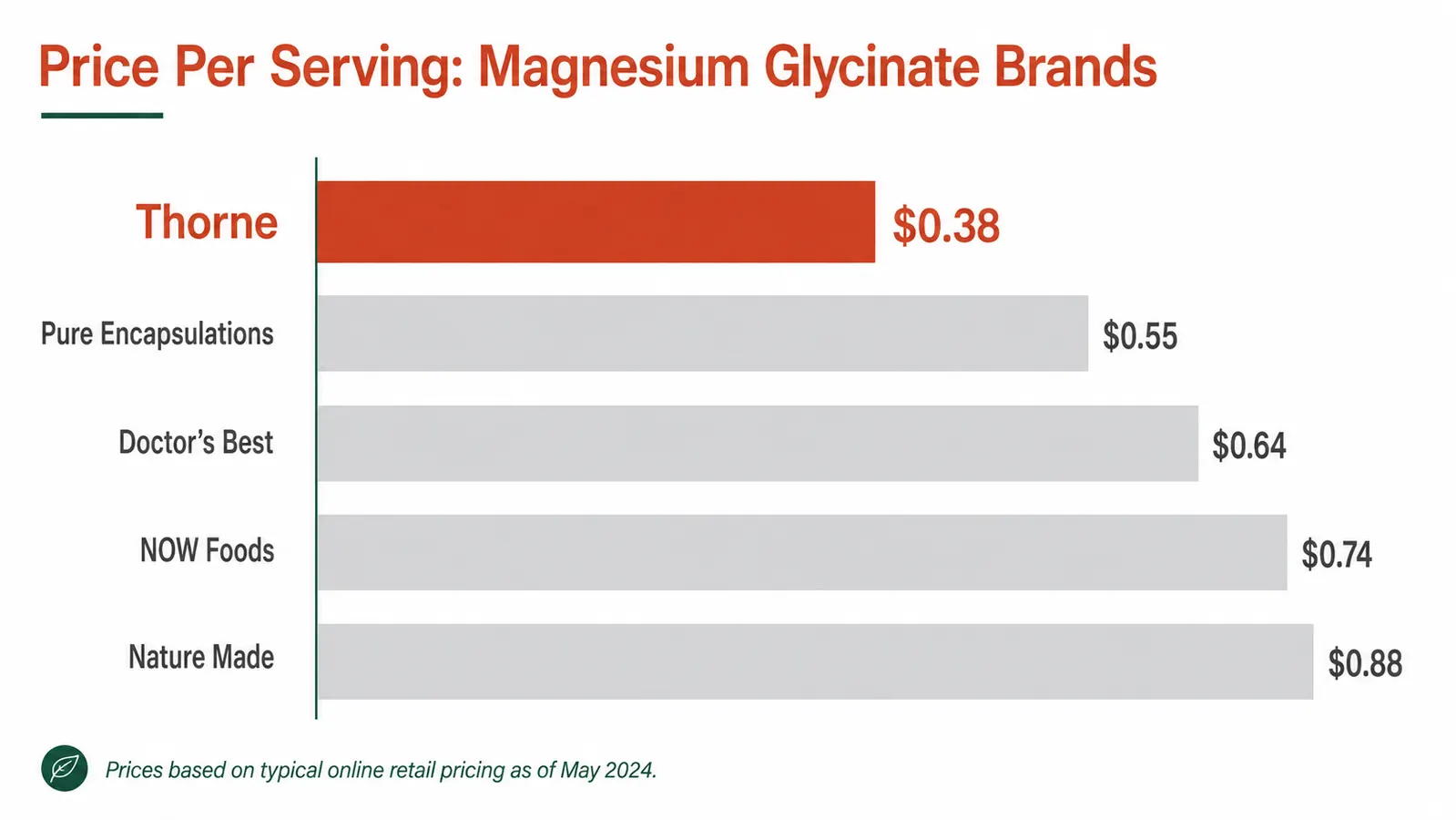
So why pay the Thorne premium? A few reasons hold up under scrutiny. Thorne is NSF Certified for Sport, which means the product has been tested for banned substances and label accuracy at a level most supplement brands do not reach. If you are an athlete or if you have a history of reacting to fillers in cheaper capsules, that certification matters. Thorne also has a longer track record of quality control than most brands their size. But if you are a retired teacher on a fixed income who just wants to sleep better, Doctors Best is a reasonable place to start.
I am not saying Thorne is overpriced. I am saying the premium is real and the justification depends on your specific situation. Do not let the Thorne label do your thinking for you.

Side Effects I Noticed and What the Reviews Skip Over
Magnesium glycinate is the most gut-friendly form of magnesium you can take. That is true and I do not want to oversell the negative here. But it is not zero side effects for everyone. In my first two weeks I had noticeably looser stools on three separate mornings. It was not severe but it was unexpected, because I had read that glycinate was unlikely to cause that. I adjusted my timing to take it with a small snack instead of on an empty stomach and the issue resolved. If you are taking this right before bed on a completely empty stomach, try moving it to 30 minutes after a light evening snack.
I also noticed that on the nights I took three capsules instead of two, which I tried twice just to see, I felt slightly groggy the next morning. The grogginess was mild and gone by 9am, but it was noticeable. Two capsules at night turned out to be the right dose for me. The bottle lists two capsules as one serving, which is 200mg of elemental magnesium. That is a moderate dose. Some people do fine at 400mg. I did not, at least not every night.
Magnesium glycinate is gentler than other forms, but start at the lower end of the dosage range. A little grogginess the next morning is your body telling you to dial back, not push through.
One more thing nobody mentions: if you are already taking a multivitamin that contains magnesium, adding a full serving of Thorne Magnesium Glycinate on top of that could put you at or above 400mg total per day. That is within the tolerable upper limit for most adults, but closer to the ceiling than I would want to be without knowing it. Check your multi first.
How This Compares to What You Would Find at the Drugstore
Most of what you see at a pharmacy or a big-box store labeled magnesium is magnesium oxide. It has the highest magnesium content by weight, which looks impressive on a label, but the absorption rate is poor. Most of it passes through without doing much. If you have tried magnesium for sleep in the past and felt nothing, there is a good chance it was an oxide formula. Glycinate is a different conversation entirely.
Magnesium citrate, which is the other common form you will find on store shelves, is better absorbed than oxide, but it has a stronger laxative effect. For sleep support specifically, glycinate tends to win out because it is the calming form. Citrate has its uses, especially for people who also deal with constipation, but if sleep is your primary goal, glycinate is where most of the evidence points. I covered this comparison in more depth in my article on magnesium glycinate vs. magnesium citrate for sleep, which is worth reading if you are still deciding between the two.

Who This Is For
Thorne Magnesium Glycinate makes the most sense for people who have already tried a cheaper magnesium glycinate and want to know if a certified, cleaner formula makes a difference. It also makes sense for athletes or active adults who care about NSF Sport certification, for people who are sensitive to fillers and excipients in cheaper capsules, and for anyone who wants to minimize the risk of buying a product that does not match its label. If you have been waking up at 3am regularly, if your legs cramp at night, or if you feel wound-up at bedtime despite being physically tired, chelated magnesium is a reasonable thing to try, and Thorne is a quality entry point.
I also think it works well for travelers. I pack it on every trip now. Disrupted sleep from time zones, unfamiliar beds, and irregular schedules is a real problem for me, and having a consistent supplement routine helps more than I expected. Two capsules, a glass of water, and a familiar habit in an unfamiliar hotel room.
Who Should Skip This Brand Specifically
If you are on a tight supplement budget and willing to do label comparison work, start with Doctors Best Magnesium Glycinate. It uses the TRAACS chelated form, is third-party verified, and costs significantly less per serving. You will get a very similar outcome in most cases. Thorne's main advantage over Doctors Best is the NSF Sport certification and brand history, neither of which matters much if you are not a competitive athlete and you are just trying to sleep through the night.
You should also skip magnesium glycinate entirely if you have kidney disease or significantly impaired kidney function. Healthy kidneys filter excess magnesium efficiently. Impaired kidneys cannot, and supplemental magnesium can accumulate to levels that cause real problems. This is not a scare tactic, it is the reason every magnesium supplement should carry a doctor-consult note for people with kidney conditions. If that applies to you, this is a conversation for your physician, not a supplement review.
Skip it also if you are currently taking medications that interact with magnesium. That list includes certain antibiotics (tetracyclines and quinolones), some osteoporosis medications, and diuretics. The interaction is typically about absorption timing, not a dangerous combination, but your pharmacist can tell you whether to space them apart. Worth one quick call before you start.
What I Liked
- Chelated bisglycinate form absorbs well and is gentle on the stomach
- NSF Certified for Sport, meaning label claims are independently verified
- No gluten, dairy, or soy, and a short, clean excipient list
- Capsule format is easy to travel with and store
- Thorne has a documented quality control track record that holds up to scrutiny
- Glycine content may contribute additional calming support beyond the magnesium alone
Where It Falls Short
- Price per serving is noticeably higher than comparable chelated magnesium brands
- 90-capsule bottle at a two-capsule dose is only a 45-day supply, shorter than many realize
- NSF Sport certification adds cost that is irrelevant if you are not a tested athlete
- Some users, including me in week one, experience loose stools when taken on an empty stomach
- Sleep benefits may level off after several months of continuous use
- No dosage guidance for people already taking magnesium in a multivitamin
The Question I Kept Coming Back To
After eight weeks with this product, the question I kept returning to was simple: would I buy it again, or would I switch to a less expensive chelated magnesium and see whether the results held? Honestly, I split the difference. I finished my bottle of Thorne, then ordered a bottle of Doctors Best to run a personal comparison. My sleep stayed consistent through both. My legs did not cramp on either. The only noticeable difference was the price.
That is useful information and I share it without embarrassment. Thorne is a genuinely good product. It is not magic that budget brands cannot replicate at the formulation level. What you are paying for is certification, brand infrastructure, and the confidence that comes from knowing the label is accurate. For some people that peace of mind is worth the extra cost. For others, it is not. Both positions are reasonable.
If you want the long-term use perspective, including what six months of nightly Thorne magnesium actually looks like week by week, I wrote that separately in my long-term review. This article was always meant to cover what that one leaves out, not to repeat it.
Still want to try Thorne? Here's the current price so you can do the math yourself.
I would not steer you toward it if I did not think it was a solid product. It helped my sleep, cleared up my leg cramps, and the quality is real. Just go in with eyes open about the cost and check your other supplements for magnesium overlap before you start.
Amazon Check Today's Price on Amazon →