

My first transatlantic flight was eleven hours. I landed in Dublin with ankles so puffy I had to sit in the gate area for twenty minutes before I could get my shoes back on comfortably. That was before I figured out compression socks. My second transatlantic flight was twelve hours. I wore the Sockwell Circulators I now pack on every trip, walked off the plane, and was on a walking tour of Trinity College two hours after customs. The difference was not subtle.
The problem most travelers run into is not skipping compression socks entirely. It is buying the wrong ones. Too little compression and nothing changes. Too much and your legs ache from the pressure. The wrong height and they bunch. The wrong fabric and your feet sweat through an overnight flight. This guide walks through exactly what to look for, in the order that matters, so you land ready to move instead of needing two days to recover your legs.
The sock I now pack on every trip over four hours
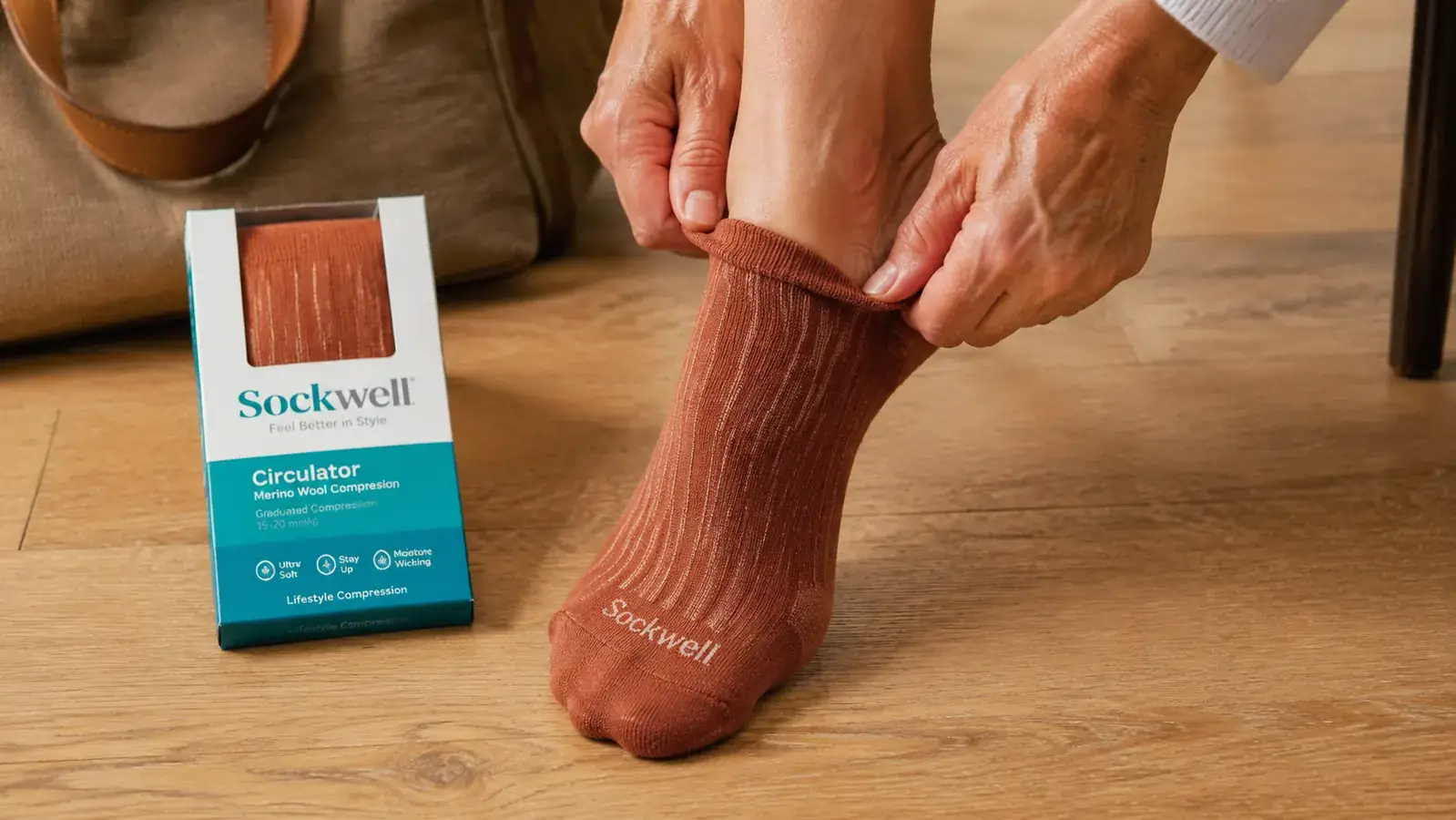
Sockwell's Circulator is a moderate graduated compression sock in a merino-wool blend. Rated 4.6 stars across more than 5,000 reviews. It is the one I recommend for active travelers over 60 who want real circulatory support without the clinical look or the sweaty synthetic feel.
Amazon Check Today's Price on Amazon →Step 1: Choose the Right Compression Level (This Is the One People Get Wrong Most Often)
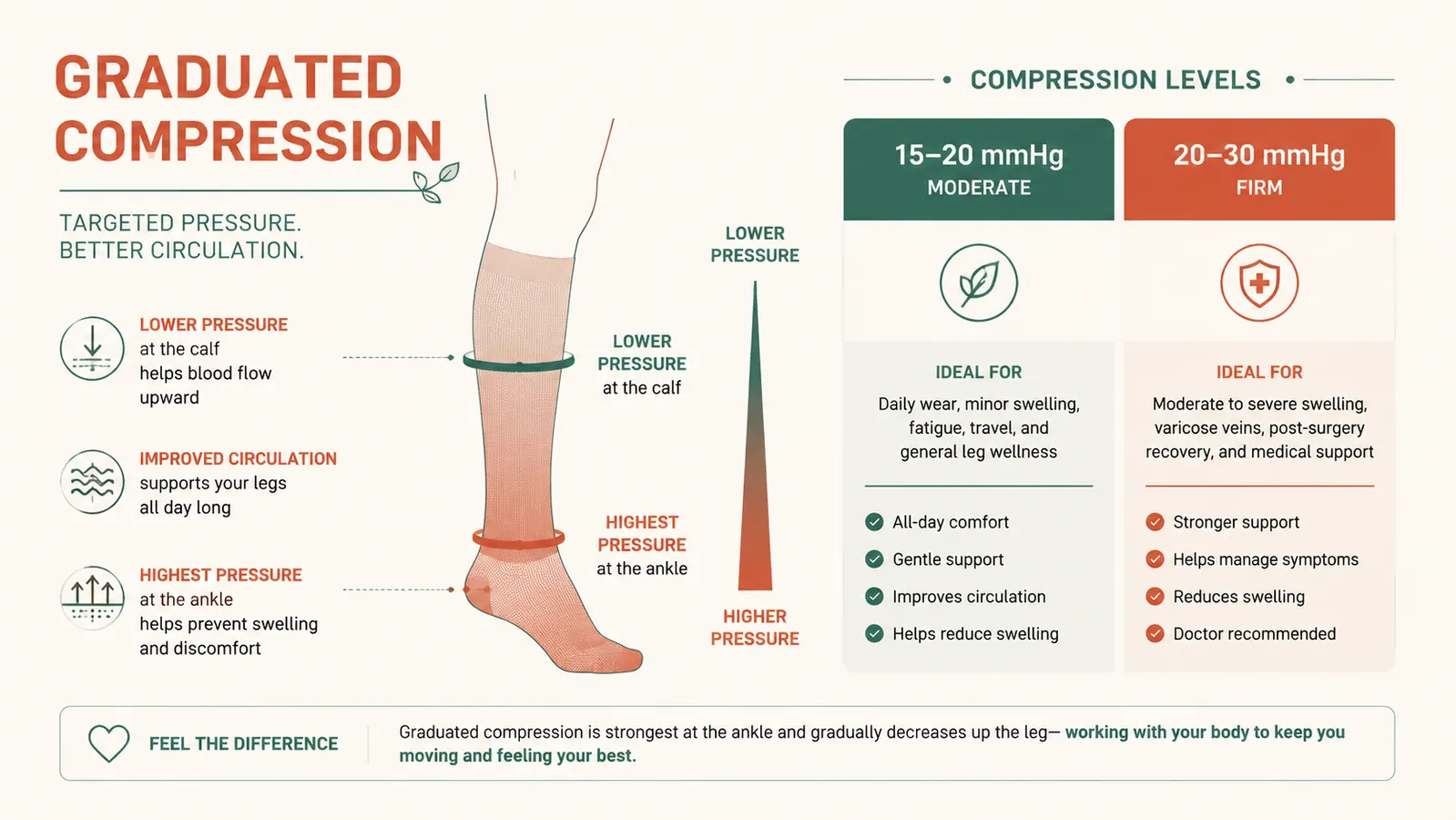
Compression socks are rated in millimeters of mercury, written as mmHg. That number tells you how much pressure the sock applies at the ankle. Two ranges matter for travel: 15-20 mmHg and 20-30 mmHg.
For most healthy adults taking long flights, 15-20 mmHg is the right starting point. This is considered moderate compression. It is enough to support circulation during the hours you are sitting with your legs bent and not moving much, without being so firm that the sock feels like it is squeezing. You can wear it for eight to fourteen hours and not feel like you need to rip it off by hour five.
The 20-30 mmHg range is firm compression. It is appropriate for people who have been told by a doctor to wear compression for a specific condition, or for those who already know from experience that moderate compression does not give them enough support. If your ankles swell noticeably even on shorter trips, or if you have a history of varicose veins, that firmer range may be worth discussing with your doctor. For a first pair bought for travel wellness, start with 15-20 mmHg. The Sockwell Circulator is a 15-20 mmHg sock and it is where I would send anyone starting out.
What to skip: anything under 15 mmHg. You will see socks marketed as light compression or support socks at 8-15 mmHg. On a twelve-hour flight, these do very little. They are fine for standing at work but not for long-haul sitting. Spend your money on the right range from the start.
Step 2: Decide on Height, Knee-High or Calf-High
For long flights, knee-high is the correct choice. The reason is straightforward: the goal of graduated compression is to help blood move upward from your foot and ankle toward your heart. A calf-height sock stops mid-leg. A knee-high sock keeps that assist going through the full lower leg. On an eight-hour or longer flight, the extra few inches of coverage makes a real difference in how your legs feel when you stand up.
I wore calf-height compression for two trips before switching to knee-high. Knee-high wins for anything over five hours, no question. The trade-off is heat: knee-highs cover more skin, so fabric choice matters even more (which is why Step 3 matters). The Sockwell Circulator comes in knee-high. On shorter connections or day trips, a calf-height is fine for lighter support, but for your main travel socks on international flights, go knee-high.
The goal of compression is to help blood move upward from the ankle toward the heart. A sock that stops at mid-calf is doing half the job.
Step 3: Pick the Right Fabric, Merino Blend or Skip It
Most compression socks sold online are made of nylon and spandex. These work, they hold compression well, and they are inexpensive. But on a long flight in recycled air with your shoes off, synthetic compression socks get sweaty and stay sweaty. Your feet overheat. By hour seven you are shifting around trying to get comfortable.
Merino wool changes this. Merino is naturally temperature-regulating, which means it keeps feet warm in cold cabin air and releases heat when your foot warms up. It also manages moisture better than synthetic fabrics, so your feet stay drier across a twelve-hour flight. The Sockwell Circulator is a merino blend: merino wool, bamboo rayon, and nylon with a touch of spandex for stretch. That combination gives you the temperature control of wool, the softness of bamboo, and the structural compression from the nylon and spandex.
The honest trade-off with merino blends is price. The Sockwell runs around $33 per pair, while a drugstore nylon compression sock might be $10 or $12. If you travel four or more times a year, the merino pair is worth it. If you are flying once to see family and want something basic, the nylon pair is fine. But for regular travelers who want to arrive feeling their best, merino or a merino blend is the right call.

Step 4: Measure Yourself and Size Correctly
Compression socks that fit poorly do not work. A sock that is too large will not deliver consistent compression. A sock that is too small will be uncomfortable and can cut off circulation at the top. Both problems are common when people buy by shoe size alone.
The correct way to size compression socks for travel: measure your calf circumference at the widest point, and measure your ankle circumference just above the ankle bone. Do this in the morning before your legs have had a chance to swell from the day. Use a flexible fabric measuring tape. Write both numbers down.
For the Sockwell Circulator, sizes run Small/Medium, Medium/Large, and Large/X-Large. The sizing chart on the product page gives you the calf and ankle circumference ranges for each size. Do not guess. I wear a Medium/Large based on my calf measurement even though my shoe size would suggest a Small/Medium. If you are between sizes, go up one. A slightly larger sock is more comfortable than one that is too tight at the calf band.
One more thing: check the top band of any compression sock you are considering. The band at the top should be firm enough to stay up but not have a tight rubber grip that leaves a mark on your leg. The Sockwell Circulator uses a non-binding top that stays up through a full flight without digging in. That is a detail worth paying attention to.

Step 5: Put Them On Before You Leave the House
This is the step most people skip, and it is the one that determines whether your compression socks actually do their job. Compression works by helping blood move upward through graduated pressure. That system works best when your legs are not yet swollen. If you wait until you are already at your seat on the plane, your ankles may have already begun to swell from sitting in the terminal and walking the concourse, and the socks are working against existing fluid retention instead of preventing it.
The right time to put on compression socks for a flight is at home, before you leave for the airport. Put them on while you are still sitting down from your morning routine. Get dressed, get your bag ready, and head out with the socks already on. You will wear them through the drive or transit to the airport, through the terminal, on the flight, and until you reach your accommodation and can get horizontal for a bit. That full run, from departure through landing, is where you get the most benefit.
If you forget and end up at the gate without them on, still put them on. Any amount of time in compression is better than none. But front-loading the wear from the start of your travel day is how you arrive with the least swelling and the most energy.
Step 6: Take Care of Them and They Will Last for Years
Compression socks lose their compression over time if they are machine-dried or washed in hot water. The heat breaks down the elastane fibers that create the graduated pressure. A pair of quality compression socks washed correctly will maintain their compression for two to three years. Washed on hot and dried in the dryer, they can lose meaningful compression in a few months.
The care routine is simple. Turn them inside out and wash on cold, gentle cycle, in a mesh laundry bag if you have one. Lay flat or hang to dry. Never put them in the dryer. For travel, I hand wash mine in the hotel sink with a small bar of soap, squeeze gently, and hang them over the towel bar overnight. They are dry by morning and ready for the next travel day. This is one of the practical advantages of the merino blend: merino dries faster than synthetic fabrics and resists odor naturally, so it handles the hand-wash-in-a-hotel-sink routine well.
What Else Helps on Long Flights
Compression socks are the foundation, but a few other habits work alongside them. Standing up every ninety minutes or so and doing a short walk to the galley or back of the plane helps circulation more than the socks alone. I set a quiet timer on my watch so I do not have to think about it. Staying hydrated matters too: dry cabin air pulls moisture out of your body, and dehydration makes blood slightly thicker and more prone to pooling. I aim for a glass of water every couple of hours and skip the alcohol on overnight flights. And keeping ankles moving while seated, slow ankle circles or flexing the foot up and down, works with the compression to keep blood moving through the lower leg.
None of these require special gear. The compression socks are the one purchase worth making. Everything else is habit and attention.
If you want to read a longer look at how the Sockwell Circulator performs over time and multiple trips, I covered two years of wearing them in detail in my full Sockwell Circulator review. And if you are not sure whether to buy proper compression socks or the cheaper flight socks you see at the pharmacy, the compression socks vs flight socks comparison covers the real differences.
Ready to stop landing with swollen ankles? Start with these.
The Sockwell Circulator is a 15-20 mmHg moderate graduated compression sock in a merino-wool blend. Knee-high. Non-binding top band. Rated 4.6 stars by more than 5,000 travelers. It is the pair I have worn on every long-haul flight for two years, and the one I recommend to anyone who asks.
Amazon Check Today's Price on Amazon →