
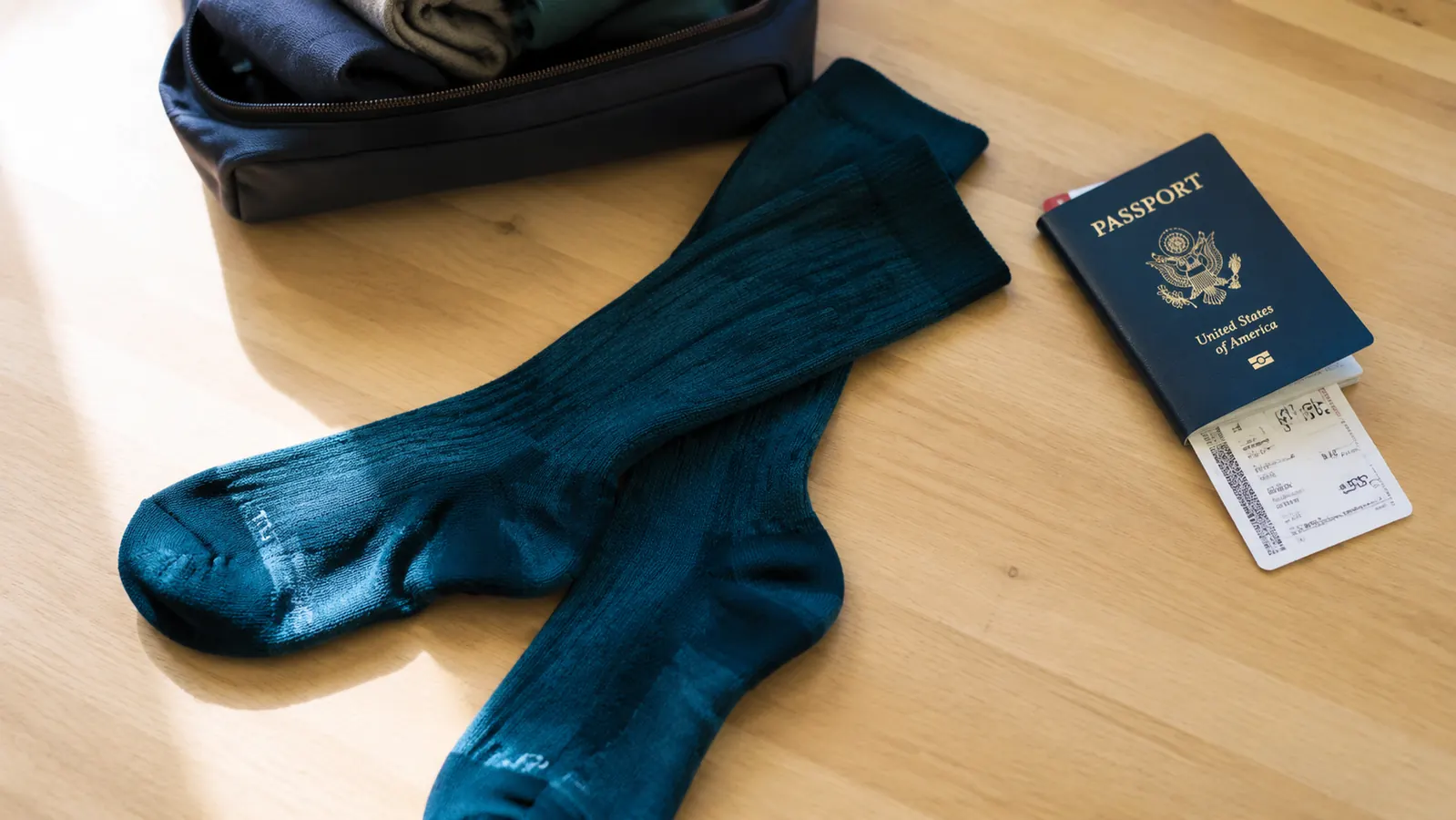
Let me tell you what actually made me pick up a pair of Sockwell Circulators. It was not a glowing review. It was my ankles on the second day of a trip to Portugal, so swollen by the time we landed in Lisbon that I spent the entire first morning in the hotel room with my feet up on a pillow instead of walking the waterfront with my husband. I had been using those beige pharmacy compression socks, the kind that come three pairs for fourteen dollars, and I thought they were doing the job. They were not doing the job. After that trip I started asking a harder question: is there a sock that actually works, and is thirty-three dollars a reasonable answer to that question? What follows is what I found, including the parts I wish someone had warned me about first.
The Quick Verdict
Genuinely better than drugstore compression socks for travel and all-day wear, but the price is real, putting them on takes practice, and they are not the right choice for everyone.
Amazon Check Today's Price →If your ankles are the reason you come home from trips exhausted, these are worth a serious look.
Sockwell Circulators are merino wool, graduated compression, and made to be worn all day. Check the current price and size chart on Amazon before you buy.
Amazon Check Today's Price on Amazon →How I Actually Tested These
I want to be upfront about my testing situation because it matters for how you weigh what I say. I am 62, five foot four, and I carry a little extra weight in my lower legs, which means fit issues show up for me that might not show up for someone with a slimmer calf. I wore the Sockwell Circulators on three separate trips over about seven months: a long-haul flight to Europe, a domestic trip to see my daughter in Seattle, and a walking-heavy vacation in Charleston in spring. I also wore them on a couple of long days closer to home, including a full Saturday at a botanical garden with my grandkids. I washed them by hand most of the time, machine-washed them twice on gentle, and I tracked how they held up across roughly twenty total wears.
I should also say what this review is not. It is not a clinical assessment of compression therapy. I am a retired health teacher, not a clinician, and nothing I write here is medical advice. What I can tell you is what these socks felt like to wear, how they held up, and whether they solved the specific problem I was buying them to solve.
The Thing Nobody Warns You About: Putting Them On
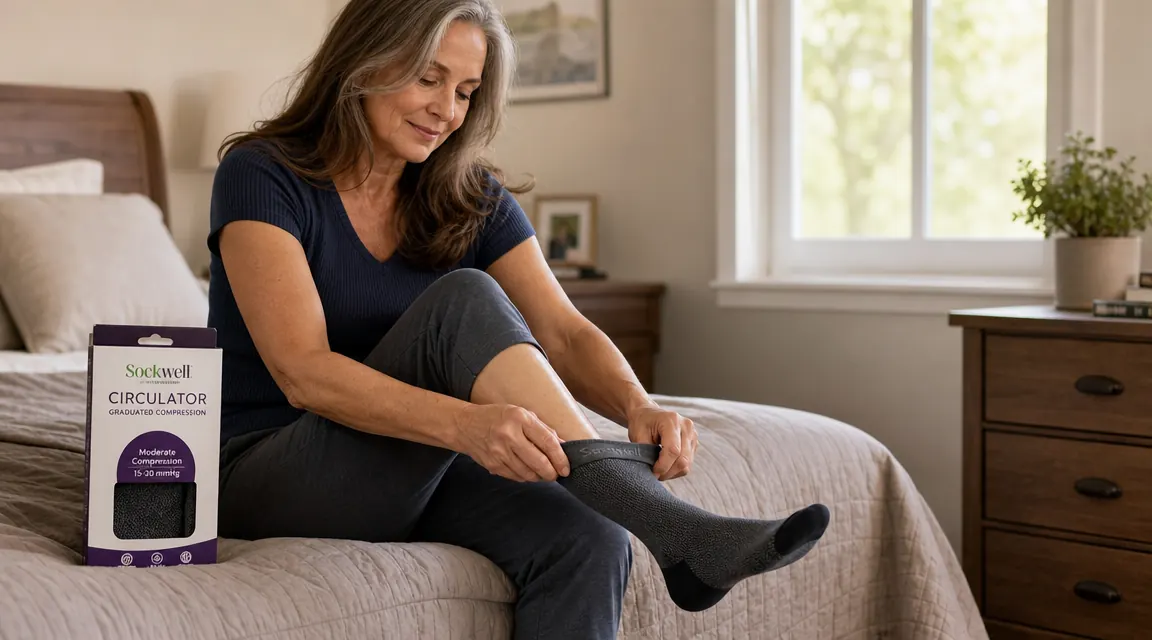
This is the part that catches people off guard, and I am going to spend some time here because I have seen too many reviews skip it entirely. Sockwell Circulators are rated at fifteen to twenty millimeters of mercury, which puts them in the moderate graduated compression range. That means they are noticeably tighter than regular socks, and putting them on requires a technique.
The first time I tried to pull a pair on the way I would any other sock, I spent four minutes struggling and nearly gave up. The correct method is to turn the sock inside out down to the heel, place your foot into the heel pocket first, then slowly roll the sock up your leg in sections. Even then, it takes real effort. If you have limited hand strength, significant arthritis in your fingers, or reduced flexibility that makes bending to your foot difficult, this is a genuine barrier. I am reasonably mobile and it still takes me about ninety seconds per sock. That is not a complaint, but it is information. Some people buy compression socks and return them within a week because they cannot get them on consistently, not because the socks are defective.
The first time I tried to pull a pair on the way I would any other sock, I spent four minutes struggling and nearly gave up. There is a technique. Once you learn it, it is manageable. But nobody tells you about the technique before you buy.
There is a tool called a sock donner or sock aid that helps enormously if dexterity is an issue. A few reviewers on Amazon mention using one with these socks specifically. If you know putting on fitted socks is already a challenge for you, factor in the cost of a donner before you decide whether Sockwells are practical.
Sizing: Where Sockwell Gets Complicated
Sockwell uses a size chart based on shoe size, which sounds straightforward until you realize that compression socks live or die by how well they fit your calf circumference, not just your foot. The Circulator comes in Small/Medium and Medium/Large, and those size buckets are broader than I would like. A Small/Medium covers women's shoe sizes five through eight and a half, which represents a pretty wide range of body types.
My recommendation is this: measure your calf at its widest point before you order. If you are at the upper end of a size range, size up, especially if your calves are fuller. A sock that is too tight around the calf creates pressure that is uncomfortable and counterproductive. A sock that is too loose does not deliver the graduated compression it promises. I ordered my usual size the first time and found the band at the top slightly too snug for all-day wear. I sized up and the fit improved substantially. Sockwell does not advertise this prominently and I think they should.
What the Merino Wool Actually Does For You
This is where Sockwell genuinely earns the price difference over drugstore options. The Circulator uses a merino wool blend, and if you have never worn merino against your skin for extended travel, the difference is real. Merino regulates temperature better than synthetic compression fabrics, so your feet are not pooling sweat inside a hot plane cabin or getting clammy during a long walking tour. More practically, merino manages odor in a way that synthetic fibers simply do not. I wore a pair for a full travel day, fourteen hours door to door, and the socks did not smell. That matters when you are taking your shoes off at security checkpoints and in tight airplane seats.
The texture is also noticeably softer than pharmacy-brand compression socks. Drugstore compression socks often have a slightly rough, medical feel to them. These feel like actual socks you would want to wear. For active adults who are going to put these on for a full day of walking, that comfort difference compounds over hours.
The graduated compression design means the tightest point is at the ankle and it gradually relaxes up the calf. That is how compression socks are supposed to work. Some cheaper options are uniform compression top to bottom, which does not support circulation as effectively. On long flights I could feel a genuine difference in how my legs arrived at the destination compared to my pharmacy sock days. My ankles were not disappearing into my shoes by the time we landed.
Durability: The Honest Picture After Twenty Wears
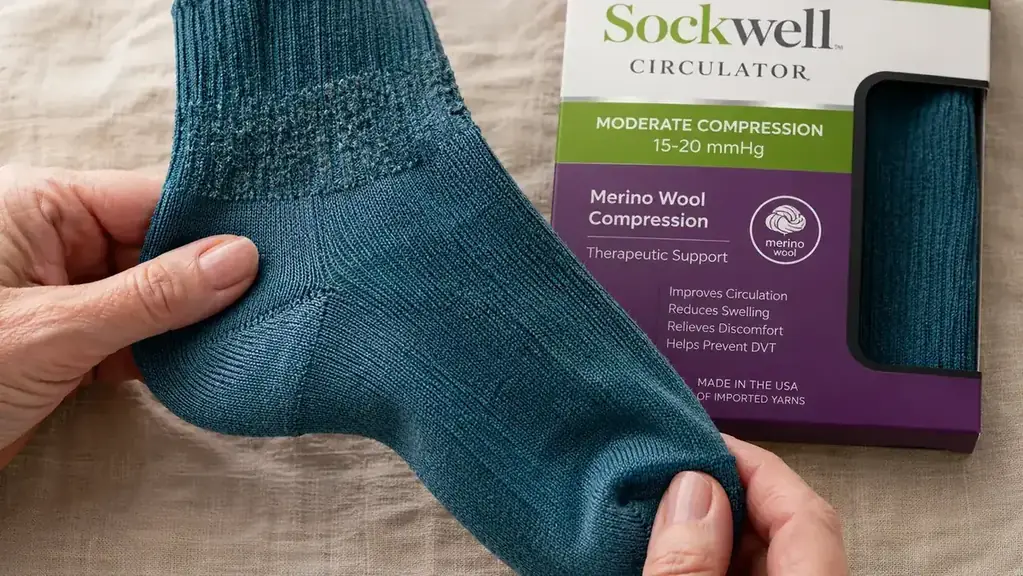
Merino wool requires more care than synthetic fabrics. That is a fact, not a criticism. I hand-washed these most of the time using cool water and a gentle wool wash, laid them flat to dry, and they held up well. The two times I put them through the machine on a gentle cycle with cold water, I noticed slightly more pilling near the ankle band than I saw after hand washing. By wear fifteen or so, there was visible pilling in the highest-friction areas: the toe box and the inner ankle. It is the kind of pilling you notice when you look closely but not the kind that affects function.
The compression still feels effective at twenty wears, which is the more important test. Many cheaper compression socks lose meaningful elasticity by wash eight or ten. These have not gone limp on me. If you care for them correctly, the compression holds. If you machine wash and tumble dry them regularly, I would expect a faster decline. Treat them like a wool sweater and they will last.
At thirty-three dollars per pair, durability is a fair thing to scrutinize. If you get forty-plus wears out of them with maintained compression, the math works out better than it looks at first glance. If you put them through a hot wash and dryer every week, you will probably replace them much sooner and the economics get less favorable.
What I Liked
- Merino wool blend is noticeably softer and less sweaty than synthetic compression socks
- Genuine graduated compression, tighter at the ankle and releasing up the calf, not uniform pressure
- Odor control is excellent for full travel days
- Holds compression well after twenty or more proper washes
- Works for all-day wear, not just flights
- Available in colors that look like regular socks, not medical equipment
Where It Falls Short
- Requires technique to put on, real barrier for people with limited hand strength or flexibility
- Sizing runs on broader buckets than ideal, calf circumference matters as much as shoe size
- Pilling appears after repeated washes, especially with machine washing
- Care instructions require attention, not a throw-in-the-laundry option
- Price is genuinely three times what pharmacy compression socks cost
- Not available in men's sizing under this product listing
The $33 Question: Is It Worth It Compared to Drugstore Options?
Here is my honest answer: it depends on what you are asking of them. If you need compression socks for occasional wear, a short flight once or twice a year, wearing them to a wedding where you will be on your feet for a few hours, then a drugstore option at ten or eleven dollars will probably serve you. The compression is real enough for light use and you will not fuss about the care instructions.
If you travel more than a few times a year, wear compression socks regularly for circulation support, or are on your feet for long stretches doing activities you care about, the merino wool difference becomes worth paying for. The temperature regulation, the odor management, and the all-day comfort change the experience in ways that accumulate across a long trip. I stopped wanting to take my shoes off in airports and scratch at the seams by hour eight. That used to happen with my pharmacy socks. It does not happen with these.
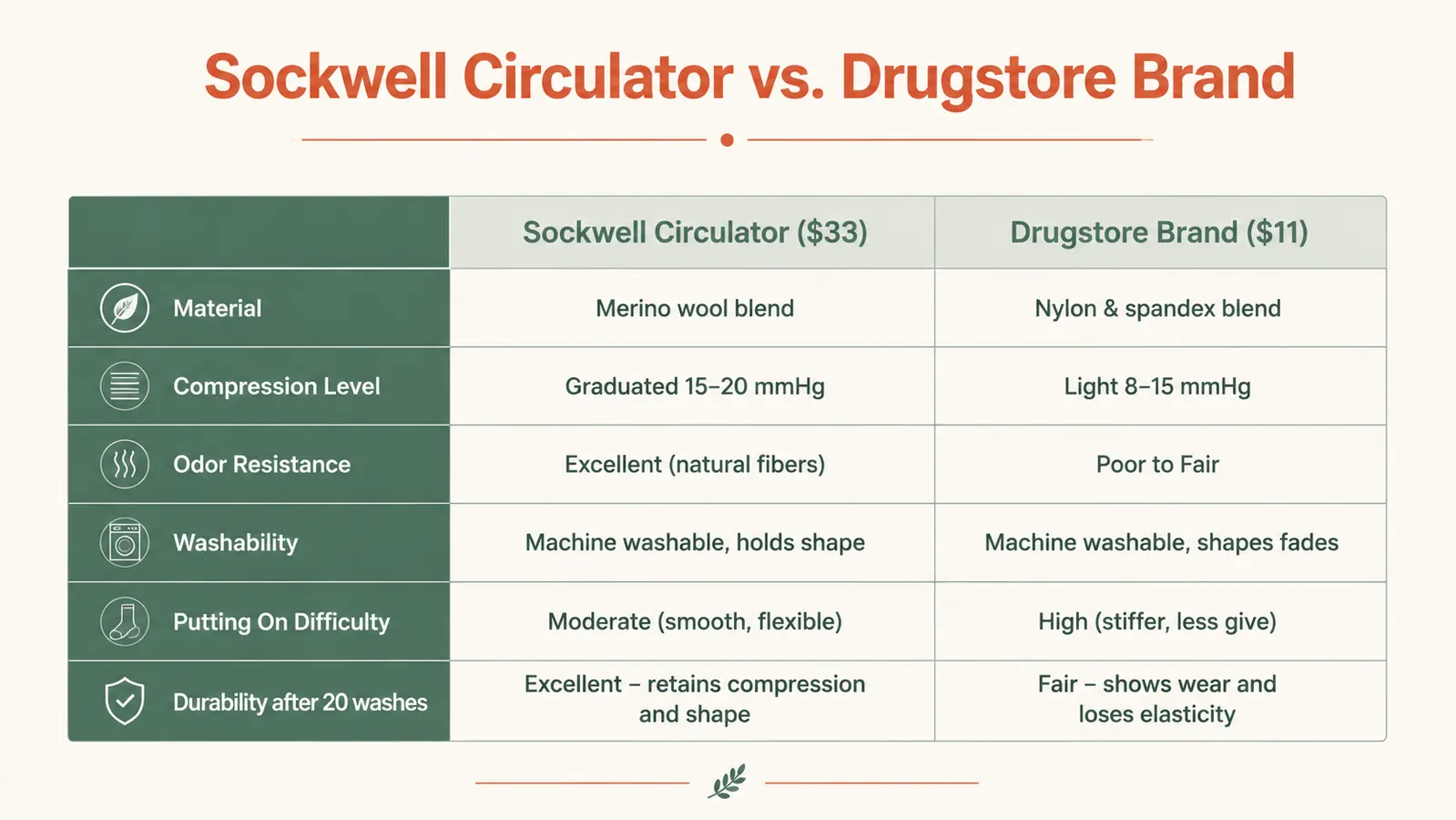
The comparison table I put together after testing both side by side gives a clearer picture. See the image in this section for how they stack up on the things that matter most to regular travelers.

Who This Is For
Sockwell Circulators are a good fit if you are an active adult who takes compression socks seriously as part of how you travel or manage your day. If you take two or more long flights a year, if you walk five or more miles on travel days, if you are on your feet for extended periods and want something that handles that without leaving you sweaty or itchy, these are worth the investment. They are also a good fit if you have tried cheap compression socks, been frustrated by how quickly they lose their stretch or how uncomfortable they get after four hours, and want something that will actually last.
Who Should Skip These
I want to be direct about this because I think some reviewers gloss over it to avoid complicating the sale. There are people for whom Sockwell Circulators, and compression socks at this level of compression in general, are not the right answer.
If you have been diagnosed with peripheral artery disease, you should not be wearing graduated compression socks without your doctor's explicit guidance. Compression socks work by applying external pressure to support venous circulation. If your arterial circulation is compromised, that external pressure can create problems rather than solving them. Similarly, if you have severe or uncontrolled diabetes with neuropathy or significant circulation issues in your feet and lower legs, please talk to your doctor before adding compression socks to your routine. This is not a liability disclaimer. It is a real consideration.
Beyond medical considerations: if putting on a fitted sock is already physically difficult for you and you do not want to invest in a sock donning aid, these will frustrate you. If you wash all your socks together in a hot machine wash with everything else, the merino will not hold up and you will be disappointed with the durability for the price. And if you need men's sizing, this particular product listing is for women. Sockwell makes a men's version but it is a separate purchase.
Also worth noting: at fifteen to twenty millimeters of mercury, these are moderate compression. If your doctor has recommended higher compression levels for a specific medical condition, you need a prescription-grade sock, not an over-the-counter option, regardless of brand.
For travelers who want their legs to arrive feeling the same way they left, these are the sock I reach for now.
After swollen ankles in Lisbon, I stopped experimenting with drugstore options. The Sockwell Circulator is what I pack on every trip now. Check the size chart carefully before ordering, and factor in current pricing, which can vary.
Amazon Check Today's Price on Amazon →